A 5kW solar system costs between $10,500 and $16,000 before incentives in 2026, with most homeowners paying around $13,000. After applying the federal solar tax credit, which currently stands at 30%, your out-of-pocket expense drops to approximately $9,100. That’s the short answer, but understanding what drives these numbers makes the difference between a smart investment and an expensive mistake.
The price you’ll actually pay depends on five key factors: your location, the equipment quality you choose, your roof’s characteristics, local labor rates, and available state or utility incentives. A homeowner in California might pay $15,000 for a premium system with microinverters, while someone in Texas could install a comparable setup for $12,500. These aren’t just random variations. They reflect real differences in permitting costs, installer competition, and regional incentive programs.
Here’s what matters most: a 5kW system typically generates 6,000 to 8,000 kWh annually, enough to offset 60-80% of an average household’s electricity consumption. At current utility rates averaging $0.16 per kWh nationally, you’re looking at $960 to $1,280 in annual savings. Factor in electricity rate increases of 3-5% yearly, and your system pays for itself in 7 to 10 years while protecting you against three decades of rising energy costs.
Sarah Chen, a homeowner in Arizona, installed her 5kW system last year for $12,800. After incentives, she paid $8,960 and now saves $115 monthly on electricity. Her system will generate over $40,000 in savings over 25 years.
Understanding the 5kW Solar System: What You’re Actually Buying
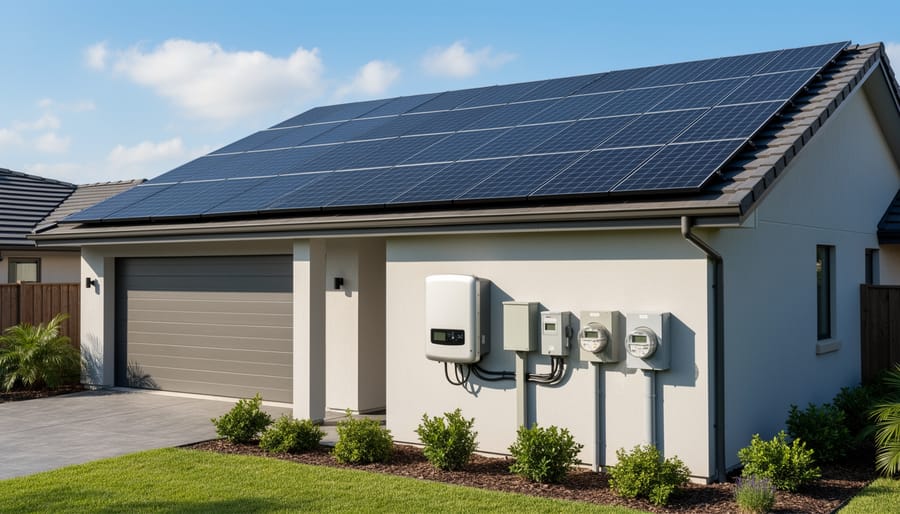
When you invest in a 5kW solar system, you’re purchasing a complete energy solution, not just panels on your roof. The package includes 12 to 16 solar panels (depending on efficiency ratings), a solar inverter to convert DC power to usable AC electricity, mounting hardware designed for your specific roof type, all necessary wiring and electrical components, and professional installation labor. You’re also getting engineering design, permitting services, and connection to the grid.
This system size suits a household using roughly 500 to 700 kilowatt-hours monthly, which covers the average three-bedroom home in many U.S. regions. If you run standard appliances, air conditioning during summer months, and typical electronics, a 5kW array often handles most of your daytime electricity needs while sending excess power back to the grid for credits. It’s not the smallest residential option, but it strikes a practical balance between cost and coverage.
That’s exactly why it’s become one of the most requested sizes. Homeowners appreciate that it provides meaningful energy independence without the space requirements or budget commitment of larger installations. If you’re wondering about the 5kW vs 10kW decision, consider your current bills and whether you plan to add energy-intensive upgrades like an electric vehicle or pool equipment. Many families start here because the numbers work: the system offsets a substantial portion of utility costs while remaining accessible for typical residential budgets and roof space.
The key is matching system size to your actual consumption patterns, not simply picking the most popular option because others chose it.
Current 5kW Solar System Pricing: The 2026 Breakdown
In 2026, a 5kW solar system costs around $13,750 before any incentives, with most homeowners paying between $11,100 and $22,400 depending on specific circumstances. This pricing represents a modest shift from 2023, when the average residential solar installation cost $2.95 per watt. Today’s market reflects adjustments in equipment costs, labor rates, and supply chain conditions that have reshaped the pricing landscape over the past three years.
The solar industry uses a per-watt pricing model to standardize costs across different system sizes. For a 5kW system (which equals 5,000 watts), you’ll typically see quotes ranging from $2.22 to $4.48 per watt. Multiply that rate by 5,000 watts, and you arrive at your total system cost. This per-watt framework makes it easier to compare quotes from different installers and understand whether you’re getting a competitive price.
| Cost Component | Per Watt | 5kW System Cost |
|---|---|---|
| Low End | $2.22 | $11,100 |
| Average | $2.75 | $13,750 |
| High End | $4.48 | $22,400 |
Several factors determine where your quote falls within this range. Premium equipment brands, complex roof configurations, and higher local labor costs push pricing toward the upper end. Conversely, standard equipment, straightforward installations, and competitive regional markets result in lower costs. The gap between the low and high ends is substantial because solar installation involves numerous variables unique to each home and location.
Geographic location plays a significant role in pricing. In California, for example, 5kW systems currently range from $15,000 to $20,750 before incentives (based on the state’s $3.00 to $4.15 per watt pricing). Colorado homeowners see slightly different rates at $3.15 to $4.00 per watt, translating to $15,750 to $20,000 for the same system size. These regional differences reflect local labor markets, permitting costs, and installer competition rather than fundamental differences in equipment quality.
Understanding these pricing fundamentals helps you evaluate quotes with confidence. When an installer presents a proposal, you’ll know whether their per-watt rate aligns with current market conditions and what factors justify pricing at either end of the spectrum. The most important insight is this: the upfront cost is just one piece of the financial picture. The federal tax credit and state incentives, which we’ll explore next, dramatically reduce what you’ll actually pay out of pocket.
Why Costs Vary: Location, Equipment, and Installation Factors
Regional Cost Differences
Location plays a surprisingly large role in what you’ll pay for a 5kW solar system. California homeowners face installation costs between $3.00 and $4.15 per watt, translating to $15,000 to $20,750 for the complete system. Just one state over, Colorado residents see a tighter range of $3.15 to $4.00 per watt, or roughly $15,750 to $20,000 total.
Why such variation? Several solar cost factors create these regional differences. States with robust solar industries, like California, have more installers competing for business, which can drive prices down in some markets while premium services push costs higher in others. Local permitting fees differ wildly: some municipalities charge $500 for solar permits while others exceed $1,500. Labor rates reflect the regional cost of living, so metropolitan areas typically command higher installation fees than rural counties.
Climate matters too. California’s intense sun exposure justifies investment in higher-efficiency panels to maximize limited roof space, while Colorado’s elevation delivers strong solar performance with standard equipment. Building codes also vary. Earthquake-prone California requires additional structural engineering and reinforced mounting systems that Colorado installations skip. State-level incentive programs further complicate pricing, as installers factor these benefits into their quote structures differently depending on local market conditions.
Equipment Quality and Brand Choices
The quality of your panel and inverter choices creates meaningful cost differences in a 5kW system, but these differences show up as value over time rather than just upfront price. Premium panels with efficiency ratings of 21% or higher cost more per watt than standard 17-18% panels, yet they generate more electricity from the same roof space and often perform better in partial shade or high temperatures. This matters because higher production means faster payback and greater lifetime savings.
Warranty terms tell you what manufacturers really think about their equipment. Budget panels typically carry 10-12 year product warranties and 25-year power output guarantees, while premium brands offer 25-year product coverage and better degradation rates. A panel that maintains 92% efficiency after 25 years will produce substantially more electricity than one that drops to 85%, and that difference compounds over decades.
Inverter technology affects both system cost and maintenance expenses. String inverters represent the most economical option for straightforward installations, microinverters add $0.30-0.50 per watt but improve performance on complex roofs, and power optimizers sit in between. The right choice depends on your roof layout and shading patterns. When installers recommend premium equipment, they’re accounting for production guarantees, lower failure rates, and the true cost of ownership beyond installation day. A slightly higher upfront investment in quality components protects your long-term return.
Federal and State Incentives: Your Real Out-of-Pocket Cost
The 30% 30% residential clean energy credit transforms the economics of a 5kW solar system from a significant investment into a surprisingly affordable upgrade. If you’re looking at that $13,750 average system cost, your actual out-of-pocket expense drops to around $9,625 once you claim the federal tax credit. In California, where 5kW systems range from $15,000 to $20,750 before incentives, homeowners pay between $8,750 and $12,110 after applying the credit. That’s a real reduction of $4,125 to $6,225, which often cuts the payback period nearly in half.
Here’s how the credit works: you claim it when you file your federal taxes the year your system goes live. If your tax liability is $12,000 and you’re claiming a $4,125 credit on a $13,750 system, you’ll owe only $7,875 (or receive a larger refund). The credit carries forward if you can’t use the full amount in one year, so even if your tax bill is smaller, you won’t lose the benefit.
Beyond the federal incentive, many states and utilities layer on additional programs. Colorado offers rebates through certain utility companies, while some California utilities provide performance-based incentives that pay you for the energy your system produces. Local programs vary widely, but common options include property tax exemptions (meaning your home’s assessed value doesn’t increase despite the solar upgrade), sales tax exemptions on solar equipment, and state-specific tax credits that stack with the federal benefit.
Financing options further improve accessibility. Solar loans let you own the system and claim all incentives while spreading payments over 10 to 20 years. Lease agreements and power purchase arrangements eliminate upfront costs entirely, though you forfeit the tax credit to the leasing company. Jumping Cable Solar Homes works directly with lenders who understand solar financing, helping you compare terms and structure a plan that aligns with your cash flow and tax situation.
The key is understanding which incentives you qualify for and how to time their application. Some programs operate on a first-come basis or have annual funding caps. Jumping Cable Solar Homes stays current on federal, state, and local programs, ensuring you capture every dollar available and navigate the paperwork correctly. That expertise often means the difference between a good deal and the best possible price on your 5kW system.

Return on Investment: When Your 5kW System Pays for Itself
Understanding the financial return on your solar investment helps you see past the upfront cost and focus on the bigger picture. Most 5kW systems pay for themselves in five to eight years, depending on your location, energy rates, and available incentives. After that break-even point, every month of reduced electricity bills is pure savings.
Let’s put real numbers to this. If your monthly electric bill runs $150 and your 5kW system offsets 80% of that usage, you’re saving roughly $1,440 per year. With an after-incentive cost of around $9,625 (based on the $13,750 average minus the 30% federal credit), your payback period lands around six to seven years. Over the system’s 25-year lifespan, that translates to more than $36,000 in total savings. The solar ROI improves even further in states with higher electricity rates or additional rebates.
The value extends beyond the monthly savings. Your system protects you from future rate increases, which historically average three to five percent annually. While your neighbors face rising bills, your energy cost stays predictable and low. Property value increases, energy independence, and reduced carbon footprint add layers of return that pure dollars don’t capture.
Financing matters here. Jumping Cable Solar Homes offers strategic options that accelerate your return, including zero-down solar loans where your monthly loan payment can be less than your previous electric bill from day one. You start saving immediately while building equity in your system. Some clients choose cash purchases to maximize long-term gains, while others prefer financing to preserve liquidity. The right approach depends on your financial goals, and our team walks you through each scenario with transparent projections specific to your situation.

Success Story: How One Family Navigated 5kW Solar System Costs
The Martinez family in Sacramento contacted Jumping Cable Solar Homes in early 2026 after receiving quotes ranging from $14,500 to $18,200 for a 5kW system. Their monthly electric bill averaged $165, and they wanted a concrete plan that made financial sense without stretching their budget. Working with our team, they received a transparent breakdown: $15,750 for their complete system (including 13 premium panels, microinverters, and full installation), which put them at $3.15 per watt given their moderately complex roof angle.
Our financing specialists walked them through applying for the 30% federal tax credit, reducing their effective cost to $11,025. We also identified a local Sacramento utility rebate worth an additional $800 that many installers overlook. The family chose a zero-down solar loan with payments of $98 per month, immediately saving $67 monthly compared to their previous electric bills.
Installation took two days in March 2026, and the system passed inspection without delays because our team handled all permitting correctly upfront. By June, the family had already seen three full billing cycles with their new solar production covering 92% of their consumption. Mrs. Martinez told us the process felt straightforward because we explained every cost component before they signed anything, and there were no surprise fees or delays.
What made their experience work was having a partner who took time to compare their actual usage patterns against system output projections, ensuring the 5kW size genuinely matched their needs rather than overselling capacity they didn’t require.
A 5kW solar system represents a significant investment in your home’s future, with 2026 pricing averaging $13,750 before incentives and dropping to a much more accessible range after the 30% federal tax credit. The numbers tell a clear story: despite variations based on your location, equipment choices, and installation complexity, the financial case for solar has never been stronger.
What matters most isn’t just the upfront cost. It’s understanding how federal and state incentives dramatically reduce your actual out-of-pocket expense, how strategic financing can make the transition seamless, and how quickly your system starts paying you back through reduced energy bills. These aren’t decisions to navigate alone.
Working with experienced professionals makes all the difference. At Jumping Cable Solar Homes, we guide clients through every step, from initial system sizing and equipment selection to maximizing available incentives and securing favorable financing terms. We’ve helped countless homeowners transform confusing quotes and complex rebate programs into straightforward, confident decisions.
The path to energy independence starts with a single conversation. Get a customized quote that reflects your specific home, location, and energy needs. You’ll see exactly what a 5kW system costs for your situation, understand your real savings potential, and gain a clear roadmap for installation.
Beyond the financial returns, you’re investing in something larger: cleaner air, reduced carbon emissions, and a more sustainable future. That’s worth more than any spreadsheet can capture.